Modeling RNA Decay Kinetics
ResearchBy Andrew AarestadPublished Project: from 2022
- kinetic modeling
- computational biology
- C++
Starting in 2022, I have been collaborating with a team at the Ameres lab at Max Perutz Labs in Vienna on a study of how cells decide which RNAs to throw away. My role on the project was cross-functional ML and model engineering: I worked directly with the experimentalists to translate their time-course assays into a kinetic model, refined the model with them as the data came in, and built the implementation that scaled it from a single substrate to the 4,096 unique sequences they ran in parallel. The kinetic modeling was a three-person effort (with David Mörsdorf and Benjamin Jordan), and the resulting framework underpins much of the paper's analysis.
The Problem
The biology, at a high level: an enzyme called Tailor modifies RNA molecules by adding short runs of nucleotides to their 3' ends one at a time, and the lab wanted to understand the kinetics of that process in detail. The experimental setup ran tailing reactions on 4,096 distinct RNA substrates in parallel, sampling and sequencing the products at a series of timepoints. The result was a time-resolved distribution over intermediate states (U₀, U₁, U₂, … U₁₀) for every substrate.
Buried in that data are the per-step rate constants k₁ through k₁₀ — how fast Tailor adds the first nucleotide, the second, and so on — but you can only recover them by fitting a kinetic model. That was my piece of the project: a model and an implementation that could pull step-resolved rate constants out of the time-course data, for all 4,096 substrates, fast enough to iterate on.
The Approach
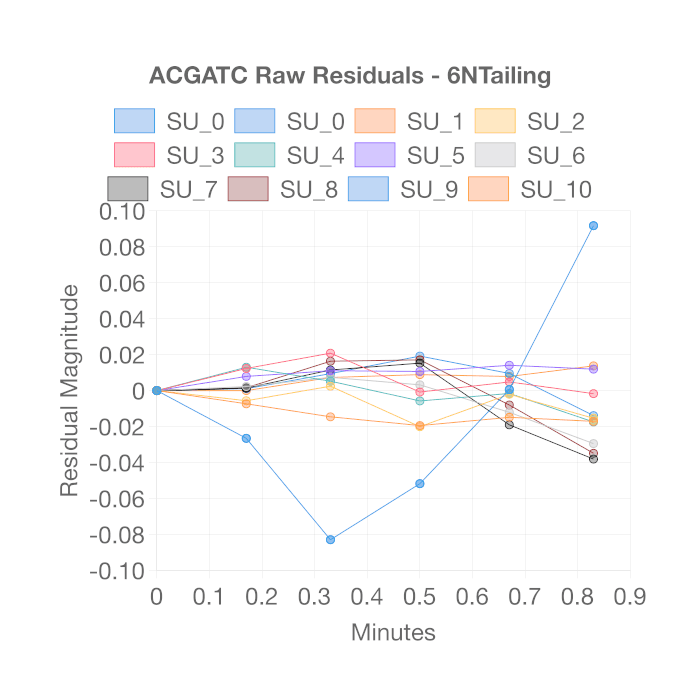
We modeled uridylation as a chain of irreversible pseudo-first-order reactions (Uₙ → Uₙ₊₁), giving a small system of ODEs per substrate with ten unknown rate constants. For each of the 4,096 substrates we solved the ODEs numerically with a 4th–5th order Runge-Kutta integrator and fit the ten rate constants by constrained nonlinear least squares (Nelder-Mead simplex) against the sequencing time series. Across replicates and experimental conditions that's tens of thousands of independent fits, so the inner solver had to be fast: I built it in C++ on top of Boost.odeint and NLOpt, then wrapped it in TypeScript and Python so the rest of the team could orchestrate runs, prep data, and slice results without touching the C++. The fits converged stably across the substrate pool, which is what made the downstream analysis possible.
Why this approach mattered
Step-resolved rate constants are a different object than the bulk averages you get from the raw time courses. With one rate constant per step per substrate, you can compare how an enzyme behaves on its first nucleotide addition versus its fifth, line that up against substrate features, and ask whether the kinetics are constant or change as the reaction proceeds — questions that aren't answerable from bulk data alone. The interesting biological patterns in the paper live in that higher-resolution view, and the fitted rate constants are what made that view possible. The specific findings are best read in the preprint.
Status
The paper is currently a preprint on bioRxiv and hasn't yet been through peer review. The modeling code will be linked here once the project's repository is public — for now, the preprint is the best entry point.