FLUID Water Meter
ProjectBy Andrew AarestadPublished Updated Project: 2015–2018
- IoT
- hardware
- signal processing
- machine learning
I cofounded FLUID in 2015 on Kickstarter to build a water monitor for homeowners. Clamp it onto a pipe, no plumber needed, and it'd track your usage and catch leaks. Residential water damage costs billions a year, but the monitoring systems that existed were expensive commercial products. We thought the market was ready for a consumer-grade product that could give you the data in an app.
We started with an off-the-shelf meter to learn the physics, then made 3D-printed prototypes and injection-molded production units. Over three years I built everything from signal processing firmware to cloud ML pipelines. The technology worked, but we couldn't find a path to the volume we needed, and the company wound down in 2018.
The Technical Challenge
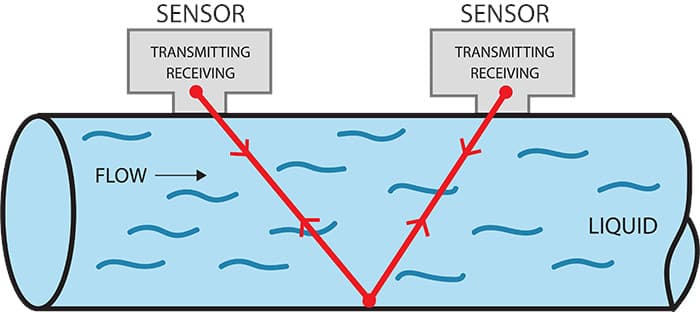
Ultrasonic flow measurement has been around for decades, but getting it to work reliably in people's houses is a different story. The concept is simple enough: send sound waves upstream and downstream, measure the time difference, calculate flow.
In practice, there are factors that make it challenging. Transducer alignment, temperature changes and air bubbles are just a few of the engineering headaches.
What We Built
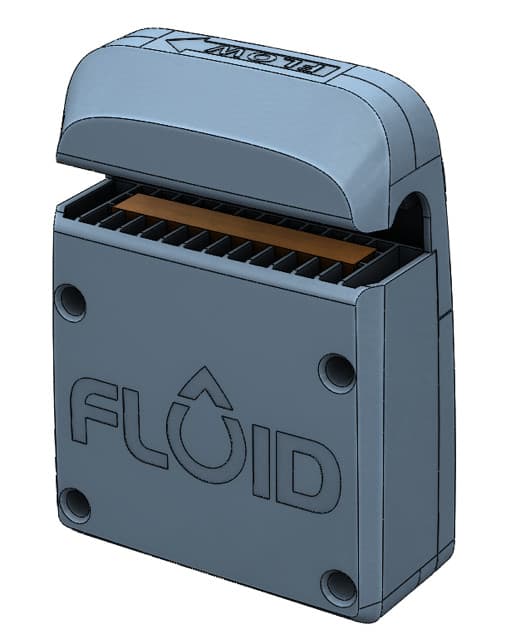
Hardware: Clamp-on ultrasonic sensor, injection-molded enclosure, custom PCBs, FPGA signal processing, power management
Firmware: C++ real-time signal processing, Kalman filtering, temperature compensation, low-power wireless
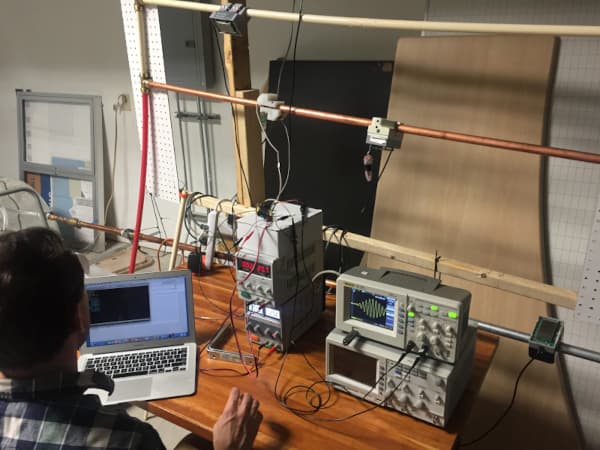
Calibration Lab: PLC-controlled water systems generating labeled datasets with known flow rates
Cloud: AWS IoT Core, Lambda, DynamoDB for telemetry processing and storage
ML: Anomaly detection for leaks, usage pattern classification, training on calibration data
Apps: Mobile (iOS/Android), web dashboard, fleet management, OTA firmware updates
Real-Time Flow Detection
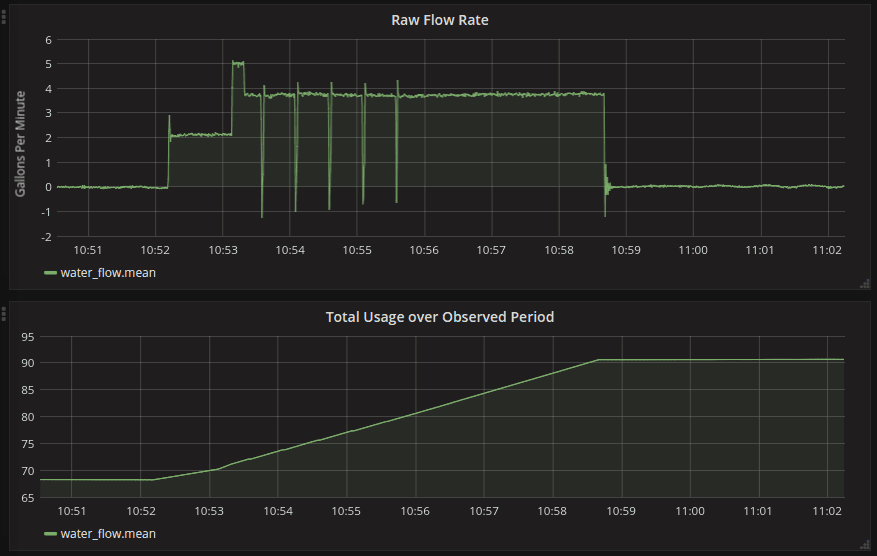
5 minutes of ultrasonic data at 1Hz showing household usage: faucet at 30s, toilet flush at 90s, shower at 2.5min. The signal processing pipeline extracted these patterns from noisy sensor data in real time.
Engineering Deep Dive
The hardest part of the whole project was getting accurate flow readings from noisy ultrasonic signals on hardware with real power constraints.
We used Kalman filtering to estimate true flow by combining measurements over time. The filter maintains a state estimate and updates as new readings arrive, weighing each measurement by its reliability. This helped smooth out the noise from air bubbles, turbulence, and temperature swings.
Leak detection isn't just about measuring flow. It's pattern recognition.
We trained ML models on data from the calibration lab. PLC-automated valves created labeled datasets with known flow rates, which gave us ground truth for training and validation. The anomaly detection models learned each household's baseline usage and flagged deviations. A running toilet looks like sustained low flow. A pinhole leak creates a constant baseline shift. The trick was distinguishing these from legitimate use like filling a bathtub.
Once a device is mounted on someone's water line, you can't exactly ask them to ship it back for a firmware update. Everything has to work remotely or it doesn't work at all. A botched update can brick someone's device, so rollbacks have to work every time, and remote diagnostics need to actually tell you what's going on.
To enable iteration on the core signal processing algorithms, I built OTA updates for not just the microcontroller but the FPGA that handled the ultrasonic measurements. We could remotely deploy entirely new signal processing logic to the hardware itself.
Manufacturing & Hardware
This is where I really learned that hardware has fundamentally different economics than software.
Injection molding tooling costs tens of thousands of dollars before you make a single part. PCB manufacturers want 1,000+ boards. Component suppliers have MOQs. The math only works at volume, but reaching volume requires capital.
From Prototype to Production
Three years from concept to production: off-the-shelf validation, 3D-printed iteration, injection-molded manufacturing.
Off-the-Shelf Sensor
Commercial ultrasonic meter to validate concept and learn time-of-flight fundamentals.
Kickstarter & 3D Prints
Kickstarter for custom sensor development. Rapid iteration with 3D-printed enclosures. Built calibration lab.
Injection-Molded Units
~100 devices with injection-molded enclosures, custom PCBs, FPGA processing. Full cloud platform, mobile apps, ML analytics deployed.
The Scaling Challenge
The technology worked. That wasn't the problem. We explored partnerships, additional funding rounds, and alternative go-to-market strategies, but we couldn't bridge the gap between where we were and the volume we needed. The company closed around 2018.
It's a common story in hardware startups, and living through it taught me something I couldn't have learned any other way: building something that works and building a viable business are two very different problems.
What I Learned
Signal Processing: Getting clean data out of noisy sensors was harder than I expected. Kalman filtering helped but needed extensive calibration. Temperature compensation mattered more than I'd anticipated. Hardware drift is real and needs to be accounted for over the life of the device.
Machine Learning: Getting labeled data was harder than building models. The calibration lab was the single most important thing we built. Usage patterns turned out to be more diverse than we planned for. "Normal" varies a lot from household to household.
Hardware Business: Design for manufacturing can't be bolted on at the end. Solving the technical risk doesn't solve the business risk. Hardware startups are capital-intensive.
Wearing Every Hat: One person can build a surprising amount of a system if you manage scope carefully, delegate the specialized work, and are willing to pick up the little things that fall through the cracks.
FLUID taught me more about building real systems than anything else I've worked on. Ultrasonic physics, ML pipelines, manufacturing economics, startup fundraising.. I got a crash course in all of it.