Ambient Temperature Estimation
ProjectBy Andrew AarestadPublished
- embedded
- physical modeling
- C++
- open source
A collaboration with Ben Jordan on a small but stubborn problem: many embedded devices need to know the ambient temperature around them, but the only thermistor they have on board reads the device's own temperature — which, because the device is running, is not the same thing. We built a physics-based estimator that recovers ambient temperature from device temperature alone, calibrated in Python against logged traces and deployed in portable C++ to the target.
The Problem
Any active device dissipates some amount of power as heat, so its internal temperature sits above ambient by an amount that depends on the device's thermal coupling to its environment and how hard it's working. For applications that need ambient — compensation for another sensor, environmental telemetry, a control loop on a heater or cooler — that offset is exactly the signal you'd like to subtract out, but you can't measure it directly on-target without adding a second, thermally isolated sensor.
The constraint that shaped the design is that calibration data is cheap to collect in the lab, where you can instrument both the device and the chamber, but on the deployed device you only ever see one channel. So the model has to be fittable against paired device-and-ambient traces and runnable, with those fit parameters frozen, against device temperature alone.
The Model
We use a single-state lumped thermal model — the device is treated as one thermal mass coupled to ambient through a single heat-transfer coefficient h, with a constant input term q that absorbs steady-state self-heating:
dT_dev/dt = h · (T_amb − T_dev) + q
That's it for the physics. h has units of inverse time and sets how quickly the device equilibrates with ambient; q has units of temperature over time and captures the heat the device is adding to itself. Both are device-specific but, for a given device geometry and duty cycle, roughly stationary — which is what makes the calibrate-once approach work.
The optimizer has two modes. In train mode it fits h, q, and the initial device temperature against a paired device-and-ambient trace. In predict mode h and q are fixed from a prior fit, and the optimizer recovers the ambient trajectory from a device-temperature time series alone. The closed-form solution is derived symbolically in a SymPy notebook in the repo, which is what makes the predict-mode inversion tractable.
The Approach
The numerical core is C++17. ODE integration is handled by Boost.Odeint's adaptive Runge–Kutta Dormand–Prince 5 stepper, which gives us error-controlled steps over calibration traces that mix fast device transients with slow ambient drift without us having to pick a fixed step size. Parameter fitting uses NLopt's Nelder–Mead simplex with a relative tolerance of 1e-8. Nelder–Mead is derivative-free, which matters here: the objective is the RMSE of an ODE solve, and while the closed-form solution makes an analytic gradient possible in principle, the simplex converges fast enough on a problem this small that the Jacobian machinery isn't worth its weight.
The lab-side binding is a CPython extension built directly against Python.h and the NumPy C-API — no pybind11, no Cython — that compiles the same C++ sources used on-target into a shared library loadable from a notebook. Calibration runs in Jupyter against logged CSVs; the resulting coefficients are handed to the embedded build, which calls the identical C++ optimizer in predict mode on the device.
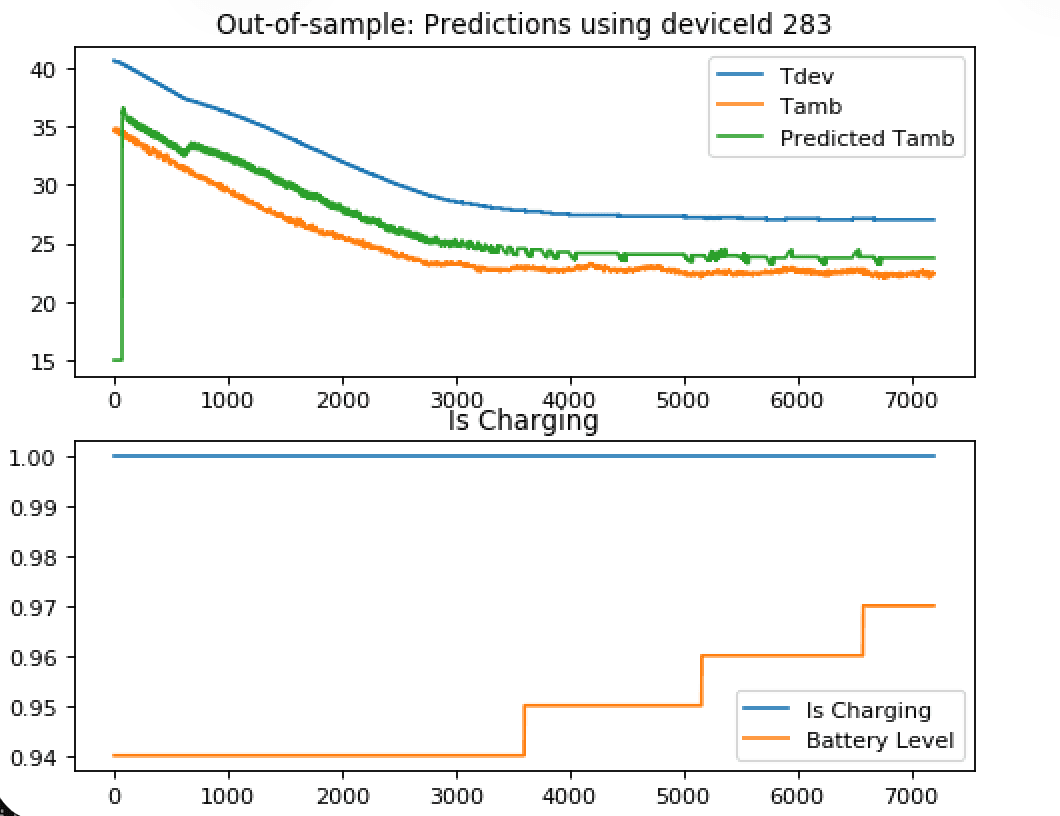
Out-of-sample run on a real logged trace: the model recovers ambient temperature (green) from the device temperature alone (blue), validated against the measured ambient (orange) that the predictor never sees.
On the lab/edge split
The piece that took the longest to get right wasn't the model — it was the boundary between calibration and inference. The usual failure mode in this kind of project is a Python prototype that fits beautifully in a notebook and then has to be translated into firmware, where the rewrite quietly introduces a sign error or an off-by-one in the integrator that no one notices until the device is in the field. Compiling the same C++ optimizer into both the Python extension and the embedded build removes the translation step entirely; the only thing that crosses the boundary is two floating-point numbers.
A black-box regressor could probably match the in-distribution accuracy here, but it would need retraining for every new device geometry and a way to ship those weights to the target. A two-parameter physical model just needs a fresh fit. The trade-off is that the lumped single-state assumption breaks down for devices with multiple thermal masses on meaningfully different time constants — a heatsinked board with a separate display module, for instance — and there the right answer is more states, not a different optimizer.